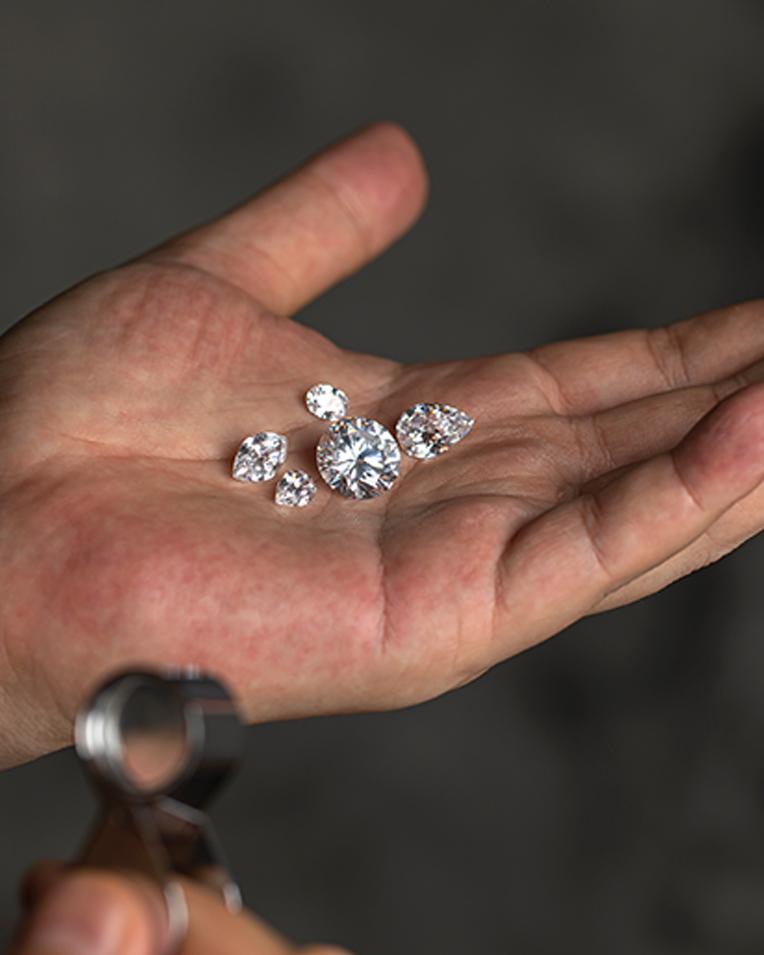
Diamond Sizes
Visual size comparisons across carat weights and shapes — so you know exactly what to expect before you choose.
A diamond's weight does not directly dictate its apparent size. For a more accurate understanding, a diamond's carat weight should always be evaluated alongside its cut grade and the distance across the top of the stone, measured in millimetres.
Several factors affect how large a diamond appears. The shape and the cut both play a significant role — some shapes of the same carat weight will look noticeably larger or smaller when viewed from above.
How Cut Affects Perceived Size
Nothing is more impactful on a diamond's brilliance than its cut, and cut also affects how large the stone appears. A well-cut diamond sparkles most stunningly, whereas a good, fair or poor cut can make a diamond look smaller than an "excellent" cut diamond of the same weight.
While carat weight is a measure of weight rather than size, it remains a consistent indicator of how large a diamond will look when viewed from the top. Different shapes distribute weight differently — an elongated marquise or oval, for example, will appear larger than a round brilliant of the same carat weight because the surface area facing upward is greater.
Choosing the Right Size
When selecting a diamond, consider both the carat weight and the shape to find the balance between visual size and brilliance that suits your preference. Elongated shapes like the oval, marquise and pear offer a larger face-up appearance, while round and square shapes prioritise symmetry and light performance.