Fluorescence
Does fluorescence help or hurt? The honest guide — including when it can lower the price without affecting appearance.
Fluorescence in diamonds is caused by the presence of certain trace elements that emit a glow — most commonly blue — when the stone is exposed to ultraviolet light. Diamonds with strong fluorescence can exhibit a slightly whitish or milky appearance in direct sunlight. However, fluorescence generally does not determine how sparkly or beautiful a diamond will be, especially in lower colour grades such as I, J, K and L.
It is important to understand that the structural integrity of a diamond is not affected by fluorescence. The natural elements that cause fluorescence do not weaken the bonding of the hardened carbon that forms the stone.
Fluorescence Grades
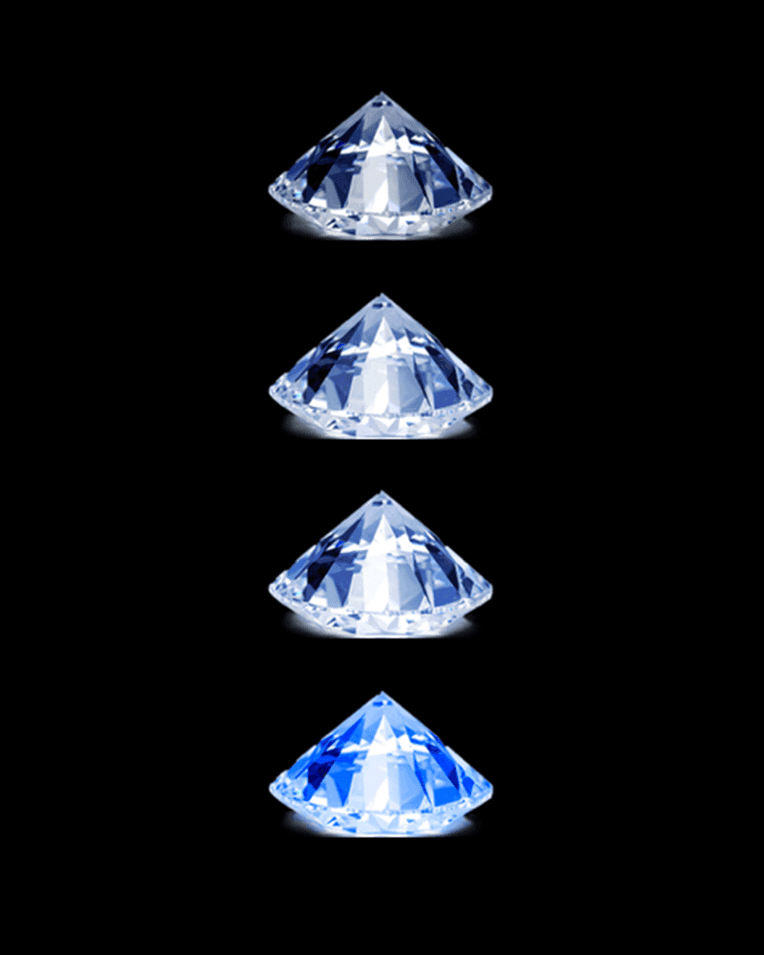
Fluorescence is graded on a five-point scale:
- —None — No glow is emitted under UV light. The diamond has no trace elements that cause fluorescence. "None" carries the largest premium and is considered the purest.
- —Faint — A very slight, soft blue glow is noticed under UV light. There is no meaningful impact on the diamond's appearance, and the value effect is nearly identical to "None."
- —Medium — A visible blue glow is emitted under UV light. Medium fluorescence can actually improve the colour appearance of lower-graded stones such as J, K or L by counteracting their yellowish tint.
- —Strong — A noticeable blue glow under UV light. Strong fluorescence can benefit lower colour grades but may cause higher colour diamonds (D, E) to appear slightly greyish or hazy.
- —Very Strong — A very bright blue glow is present under UV light. The diamond's face-up appearance may be affected, potentially making the stone look grey or hazy in normal lighting conditions.
The Changing Perception of Fluorescence
The perception and value accorded to fluorescent diamonds have evolved considerably over the years. Before the age of diamond certification, "blue-white" diamonds were among the most sought-after stones by European merchants.
In the 1970s, diamonds with very concentrated blue fluorescence — particularly D-colour stones with strong blue fluorescence and low transparency — began to be devalued due to the milky or hazy effect they could produce. In the years that followed, even F-colour diamonds and those with weaker fluorescence lost value.
Today, fluorescence remains a nuanced topic. For diamonds in the D to F colour range, the market generally favours stones with no fluorescence. For diamonds in the I to L range, medium or strong blue fluorescence can be a genuine advantage — making the stone appear whiter without any negative visual impact, often at a lower price.