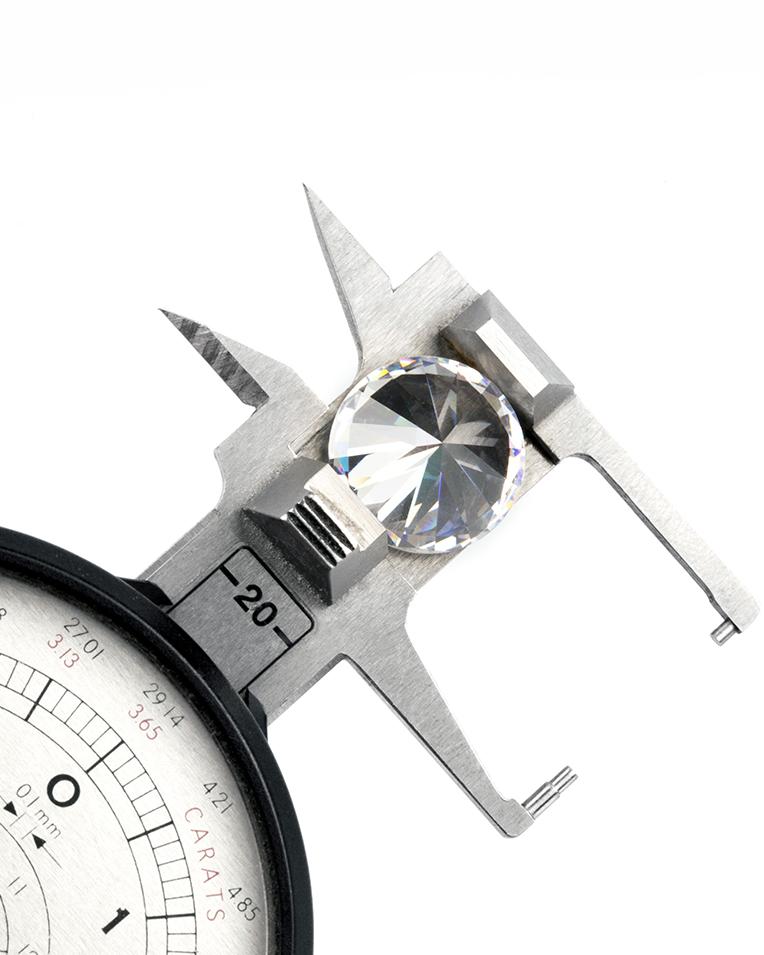
Carat Weight
Carat is weight, not size. Understand how cut and shape affect how large a diamond appears — and how to get the best value.
Carat is the standardised unit of measurement for a diamond's weight. One metric carat is defined as 200 milligrams, and each carat is subdivided into 100 "points," allowing measurements to the hundredth decimal place. A jeweller may refer to a diamond weighing 0.25 carats simply as a "twenty-five pointer."
It is important to note that two diamonds of the same carat weight will not necessarily appear the same size. The distribution of weight and the quality of the cut are the two most important factors that determine how large a diamond looks. A cut aimed primarily at maximising carat weight will often compromise sparkle — a balanced cut-to-carat proportion is ideal for the most beautiful diamond.
The Relationship Between Cut and Carat
There is a significant trade-off between a diamond's weight and its sparkle. If a cut is aimed at increasing weight, the resulting stone is likely to have a lower cut grade. Large diamonds with poor cut grades are not worth the premium because they have diminished brilliance.
Sparkle is essentially the light performance of the diamond. If the cut is not well proportioned, light leaks from the sides and bottom instead of reflecting out through the top. A diamond that is too shallow or too deep will have a low cut grade. The most enchanting diamonds maintain a careful balance between carat weight and cut quality.
Origins of the Carat System
Carat weight originated with the carob seed — early gem traders used the small, uniform seeds as counterweights in their balance scales. Before universal adoption of the metric carat in 1907, a variety of local measurements were used. Today, the carat is the same milligram weight in every corner of the world and is a standard reference point on the certificate of any diamond, regardless of which institution certifies it.
A one-carat diamond weighs 0.20 grams. It typically takes about 250 tonnes of rock mining to produce a single one-carat diamond, which is why diamonds are both rare and valuable. Diamond cutters prioritise maximising carat weight — the larger the diamond, the rarer and therefore more expensive it is. Diamonds are weighed very precisely, to the nearest 0.01 carat.
How Carat Weight Affects Price
Diamond pricing increases exponentially — not linearly — as carat weight increases. Once a diamond reaches a "critical weight," the price per carat steps up significantly. The critical weights are:
- —0.30ct, 0.40ct, 0.50ct, 0.70ct, 0.90ct
- —1.00ct, 1.50ct, 2.00ct
- —3.00ct, 4.00ct, 5.00ct, and 10.00ct
Understanding "Magic Sizes"
You can save a meaningful amount on an engagement ring by being aware of "magic sizes" — the carat weights that command a premium simply because they are in high demand or sit at a critical weight threshold. Although there is no visual difference between a 1.99ct diamond and a 2.00ct, the 2.00ct can cost significantly more. Diamonds that fall just below these thresholds are called "off-size diamonds," and they can be the key to getting the ring of your dreams at a more attractive price.
Popular Carat Weights
The most popular weight range for diamonds is one to two carats, with round-cut one-carat diamonds being the most common choice. Step-cut shapes such as the emerald cut tend to have slightly higher weights due to their broader table dimensions and deeper depth percentages.
Shapes like the pear or marquise tend to have larger surface areas compared to other shapes of the same carat weight. These shapes are recommended for those who prefer a larger-looking stone while maintaining a balanced cut-to-carat ratio within a given budget.
A useful tip when selecting a diamond: always keep your cut preference in sync with the carat weight. A diamond's true beauty lies in its brilliance, not its heaviness.