Diamond Colour
The GIA colour scale from D (colourless) to Z (faint yellow) — how colour affects value and appearance in white diamonds.
The finest diamonds in the world are transparent and completely colourless, with not the slightest trace of a hue. A diamond's colour is one of its most significant characteristics, forming one of the four primary measures of quality known as the 4Cs: cut, colour, clarity and carat weight.
Experts consider colour to be the second most important factor in the overall appearance of a diamond, after cut. This is because the human eye detects a diamond's sparkle before perceiving its colour. The purest white diamonds have a completely colourless light reflection — the standard tint of a flawless transparent stone.
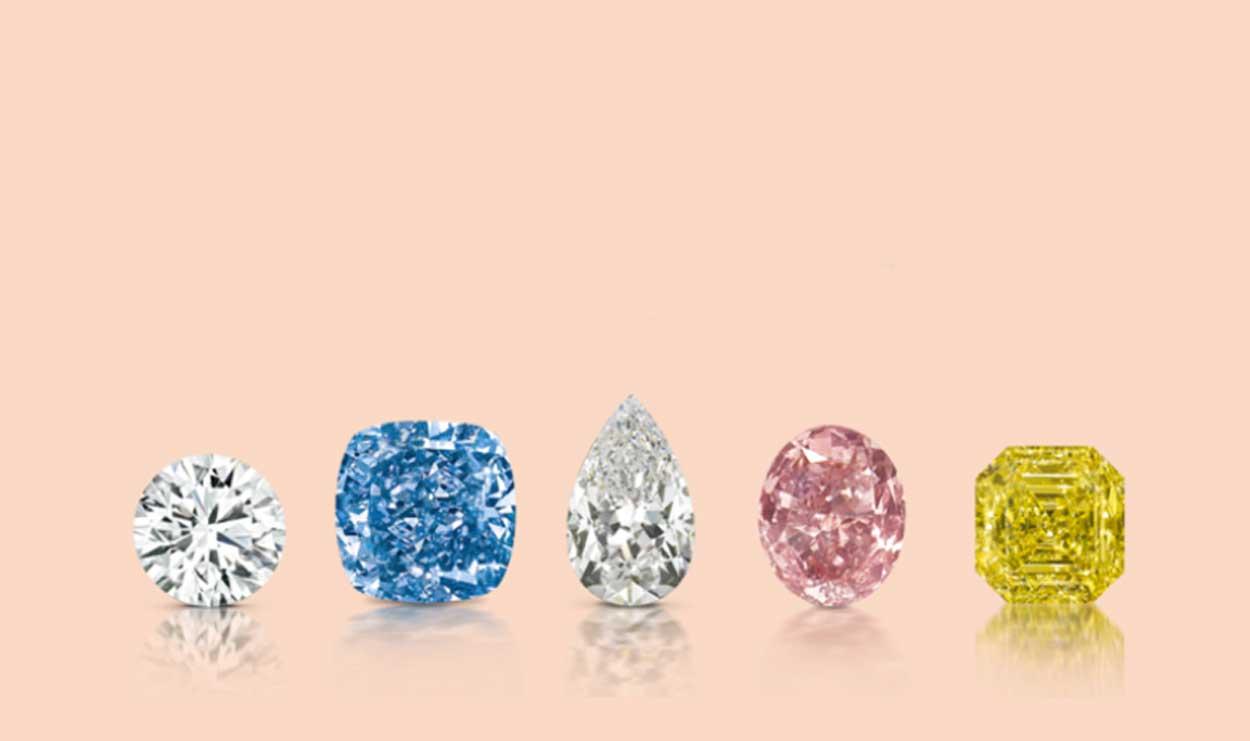
You may encounter diamonds with a yellowish, pinkish or bluish hue. While these are sometimes sold as fancy-colour diamonds, the highest-quality white diamonds are transparent, and any tint in a white diamond is considered an imperfection. White diamonds are graded from D (colourless) to Z (light yellow) on a classification scale created by the Gemological Institute of America (GIA).
Diamond Colour Grading
Diamonds are ranked on a colour grade scale — a standardised measure of quality established by internationally recognised gemstone laboratories. A diamond's ranking deteriorates as the level of detectable colour tint increases. The scale follows a top-down grading system, with the most transparent, hue-free diamond ranked highest.
The most perfect diamond — one with completely colourless reflections — is graded D. The lowest grade, Z, is assigned to stones with noticeable yellowish or pale tint visible throughout the body. The colour grading scale therefore runs from D to Z in alphabetical order with descending transparency.
Grading is based on a comparison method: the test stone is set alongside a master set of reference diamonds, and a trained professional determines its rank on the scale. Diamond colour is evaluated by examining the body colour of the stone on a pure white background, face-down.
The Colour Scale
The GIA colour scale is the universal standard. In this system, D is the highest colour grade and Z is the lowest. The scale is divided into several ranges:
- —D — Categorically colourless and the rarest of all gem-quality diamonds
- —E–F — Colourless; extremely slight traces of colour detectable only by a trained gemologist under controlled conditions
- —G–H — Near-colourless; very faint tint perceptible only to an expert eye, with G being the most popular colour grade for its balance of beauty and value
- —I–J — Near-colourless with a slight warmth; the tint is minor and largely ignorable to the untrained eye
- —K–M — Faint colour visible to the naked eye, lighter than the N–Z range but still noticeable
- —N–Z — Noticeable tint, usually yellowish or pale, clearly visible without magnification
Individual Colour Grades
A D-colour diamond possesses the highest colour purity and is a symbol of perfection. It is considered extremely rare, with no recognisable shade of colour. To the naked eye, E and F colour diamonds can appear virtually identical to a D.
An E-colour diamond is visually stunning with very high colour purity. Even under 10x magnification, it will not show any tinge of yellow. An F-colour diamond contains a minute shade of colour that is undetectable by the untrained eye, while still being considered very rare with high colour purity.
G-colour diamonds are almost completely hue-free and represent the most popular colour grade, offering an excellent blend of beauty and value. H-colour diamonds are equally popular for their visual attractiveness — a slightly identifiable shade does not affect the diamond's brilliance.
I-colour diamonds provide excellent value, as the yellow tint is not easily perceptible to an untrained eye. J-colour diamonds have a slight yellow warmth that is typically only visible when viewed next to higher-graded stones.
K-colour diamonds do not compromise sparkle but have a noticeable hue. L-colour diamonds display a yellow tint visible to the naked eye in normal lighting, making them a considerably more affordable option than those in the G to J range.