The Cut
Why cut is the most important of the 4Cs — how proportions, symmetry, and polish determine how brilliantly a diamond returns light.
It is a common misunderstanding that a diamond's cut refers to its shape. The two are completely distinct aspects of design. Shape describes the apparent form of the stone — round, pear, heart, emerald, and so on. Cut, by contrast, is the measure of how well a diamond reflects light — its sparkle.
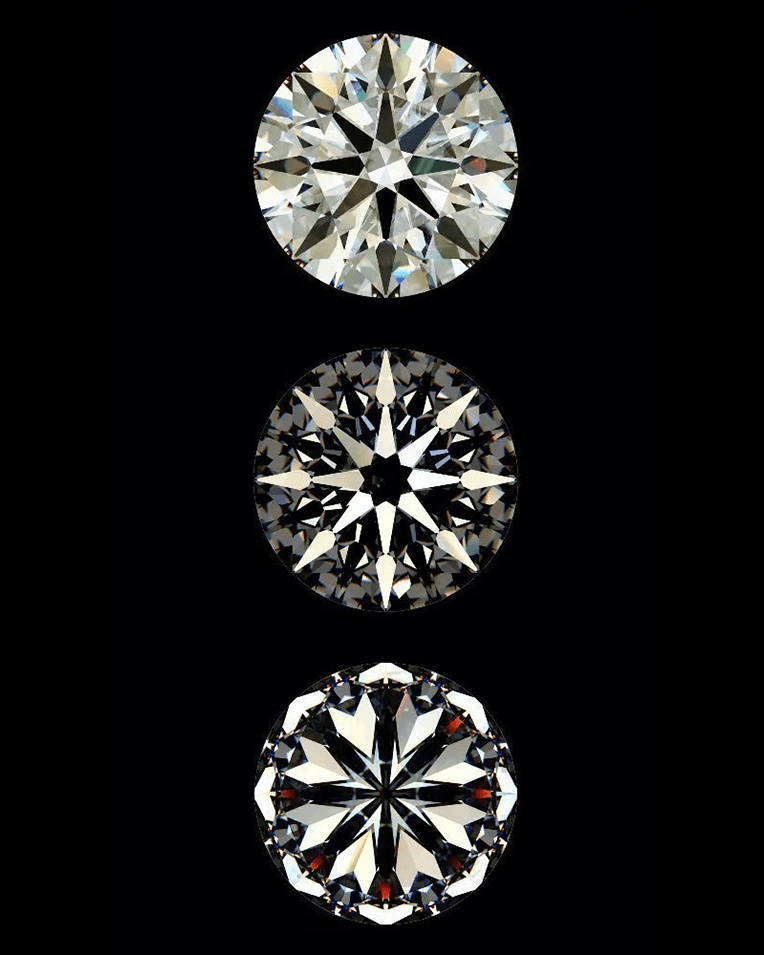
A diamond's radiance is controlled by its cut. Nothing is more impactful on a diamond's brilliance than the quality of its cut. A well-cut diamond reflects light out through the top of the stone (the table). If the cut is too shallow, light escapes from the base; if too deep, it leaks from the sides.
The GIA grades cut by precisely measuring the angles and sizes of the facets, including the table, depth, girdle, pavilion, crown and culet. Polish and symmetry also contribute. All of these factors come together to determine the cut grade. Each diamond shape and size has ideal cut proportions.
Diamond Cut Grades
Diamond cuts are graded from lowest to highest quality based on the dimension and quality of light reflection. The following grades are the standard classifications:
- —Excellent — Symmetry, angles, proportions and light reflection are as close to perfection as possible. Represents approximately the top three per cent of diamond quality. These stones reflect virtually all the light that enters them.
- —Very Good — Represents roughly the top fifteen per cent of diamonds. Reflects nearly as much light as an Excellent cut, with only a marginal difference perceptible to trained professionals.
- —Good — Reflects notably less light than Very Good, representing about a quarter of all diamonds. Good cut diamonds offer significantly lower cost while retaining attractive sparkle.
- —Fair — The lowest cut quality approved for jewellery by experts, representing about thirty-five per cent of diamonds. These stones return a reasonable but limited amount of light.
- —Poor — Diamonds with a Poor cut allow most light to escape, producing a lifeless appearance. This grade is generally never used in fine jewellery.
How Cut Affects Appearance
Precise artistry and workmanship are required to fashion a stone so its proportions, symmetry and polish deliver the magnificent return of light only possible in a diamond. A diamond should be cut proportionally — neither very shallow nor very deep — given its dimensions. The cut affects appearance in three key ways:
Brilliance
Brilliance is the brightness created by the combination of white light reflections inside and on the surface of the stone. A diamond needs more than just bright light return to appear brilliant — it also requires contrast between bright and dark areas, so that the light it produces appears more intense. Diamonds with poor light return will look darker, duller or lifeless.
Fire
Fire is the dispersion of white light into all the colours of the visible spectrum. The way a diamond catches the light is what produces those beautiful flashes of rainbow colour. Fire is most visible in darker, more dimly lit environments with fewer, more directional light sources.
Scintillation
Scintillation is the pattern of flashes — light and dark — that a diamond produces when the stone, the light, or the viewer is in motion. For scintillation to occur, there must be enough structural contrast in the facets to bounce light around. It is most visible in well-lit environments and is what gives a diamond its dynamic, living sparkle.